Door Hardware Cross-Reference
Find Door Hardware Substitutions, Down to Every Configuration Option
The project specifies one manufacturer; you get better pricing from another. Conversant finds the cross-manufacturer candidate for the exact line, maps its options onto the other manufacturer's catalog, and shows what matches, what differs and what still needs a decision.
Free in the pricebook. No login.
Why aren't cross-reference charts enough?
Manufacturers and distributors publish cross-reference charts that pair one manufacturer's series with another's, and they usually warn that similar products are not necessarily identical. That warning is the job: a substitution is judged on the complete configured product, not the product family.
- Charts pair product series. An order number also carries the arm, the function, the trim, electrified options and the finish.
- The same finish can carry a different code in each manufacturer's book.
- Two products in paired series can still differ in body, mounting pattern or certification, and the chart doesn't say where.
- A chart gives the candidate. A substitution request needs the point-by-point comparison behind it.
Example: an LCN 4040XP closer, crossed three ways
Specified
LCN 4040XP SCUSH 689
Spring cush-n-stop arm, 689 aluminum, priced from LCN's book.
Asked for
Norton Rixson, SARGENT, dormakaba
One manufacturer at a time, by name.
Norton Rixson: CPS7500 689
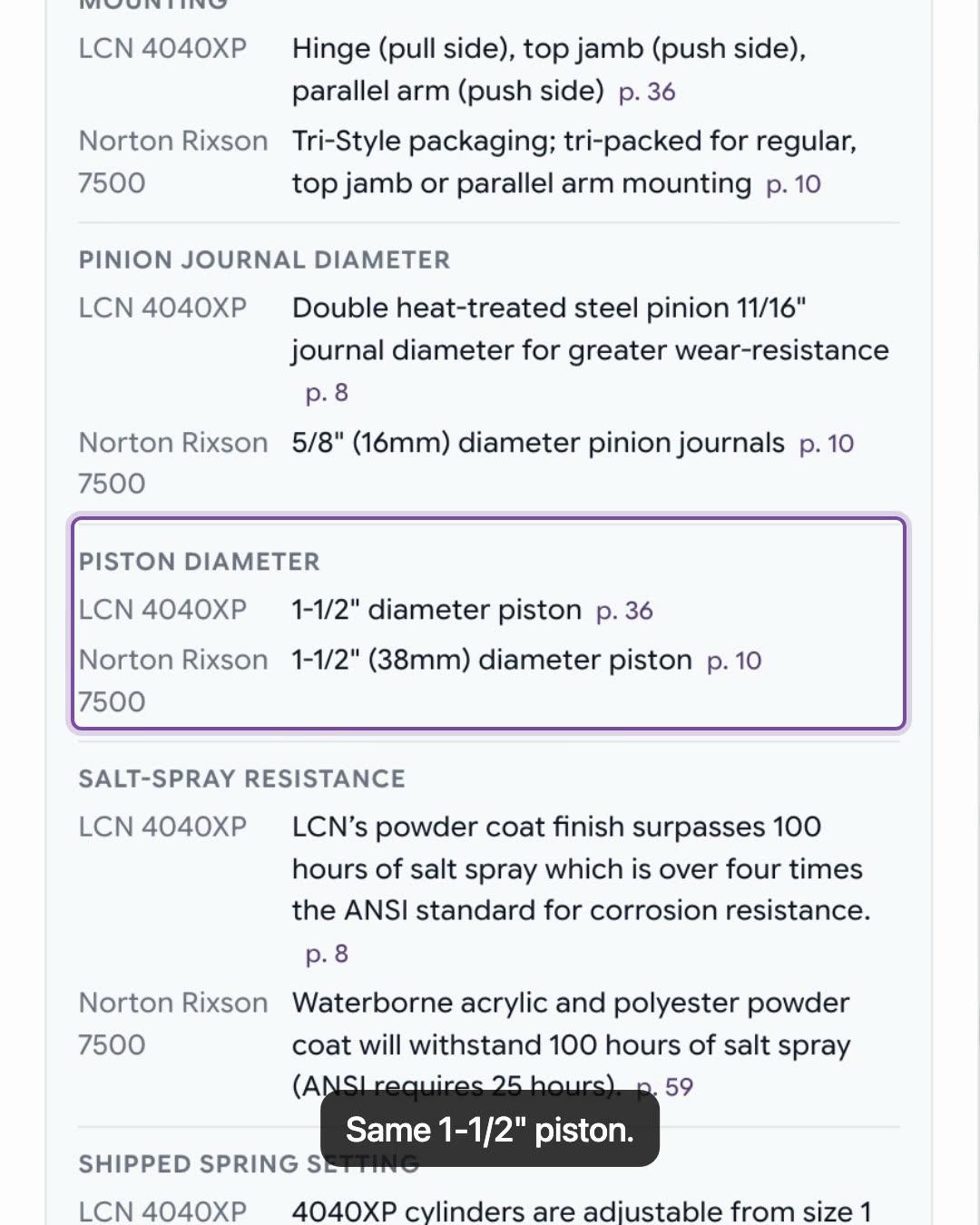
The published cross-reference returns Norton's part, on the same spring cush-n-stop arm. Both catalogs are on file, so the answer puts their printed specifications side by side: the same 1-1/2" piston, a cast iron body against cast aluminum, and a different mounting hole pattern. Each row links to the catalog page it was printed on.
SARGENT: 281 CPS EN
SARGENT's book codes the same finish differently: 689 in LCN's book is EN in SARGENT's, and the answer says so instead of carrying 689 across.
dormakaba: three candidates
The series has three models: 8916, 8956 and 8907. The answer asks which one rather than guessing, and the card labels every result as a candidate from a published guide, not an approved equal.
Video transcript
- 0:00
- A door hardware spec names a product, like an LCN 4040XP closer.
- 0:04
- A distributor who carries Norton wants to bid a substitute, because that's the brand they carry. To do that, they need the matching part, and proof that it is equal.
- 0:11
- And the architect leveling the bids needs that same proof, point by point, before accepting the swap.
- 0:16
- Today, both sides build it by hand: two catalogs, page by page, and a spreadsheet.
- 0:20
- Now you can do this with Conversant's pricebook service. Start from the line itself.
- 0:24
- Ask for the Norton equivalent by name. The published cross-reference returns its part, already on the spring cush-n-stop arm.
- 0:30
- Then put the two catalogs side by side. Same inch-and-a-half piston. Cast iron against cast aluminum. And a different hole pattern: on an existing door, that means new holes or an adapter plate.
- 0:40
- Every row is the manufacturer's own wording. Click the page, and there it is.
- 0:44
- Now try Sargent. Same finish, a different code, and it tells you so.
- 0:48
- And dormakaba has three models in that series, so it won't pick one for you. That call, like the approval, stays with the reviewer.
- 0:55
- Try it yourself, at conversant.ai/pricebook.
Selected an alternative for your project? See how Conversant generates manufacturer submittal cut sheets with the specified options highlighted.
Compare what matters, point by point
What the example establishes, row by row. The specification lines are each manufacturer's own printed wording, with the page it appears on.
| Detail | Specified: LCN 4040XP | Candidate | Result |
|---|---|---|---|
| Piston diameter | 1-1/2" diameter piston (LCN p. 36) | 1-1/2" (38mm) diameter piston (Norton p. 10) | Matches Same piston size. |
| Body | Cast iron body (LCN p. 36) | Cast aluminum body (Norton p. 10) | Differs A different body material for the reviewer to accept or reject. |
| Mounting hole pattern | 2-1/4" x 5" mounting hole pattern (LCN p. 36) | 2-3/8" vertically x 6-3/4" horizontally (Norton p. 19) | Differs On an existing door, new holes or an adapter plate. |
| Pinion journal | 11/16" journal diameter (LCN p. 8) | 5/8" (16mm) diameter pinion journals (Norton p. 10) | Differs A smaller journal on the candidate. |
| Finish (SARGENT) | 689 aluminum, in LCN's book | EN, in SARGENT's book: 281 CPS EN | Code changes SARGENT's book codes this finish EN, and the answer says so instead of carrying 689 across. |
| Model (dormakaba) | LCN 4040XP | Three candidates: 8916, 8956, 8907 | Needs a decision The series has three models, so it asks instead of picking one. |
From a specified part number to a reviewed alternative
Read the specified line
The line is priced from its own manufacturer's book, so every option code on it is decoded before anything is crossed.
Find the candidate
Ask for a manufacturer by name. A published cross-reference guide supplies the candidate, on the same arm, function or device type.
Map what the guide leaves out
When the guide doesn't cover the whole configuration, each option is mapped onto the target catalog's own codes, and the target price book assembles and prices the part number.
Compare and flag
Where both catalogs are on file, their printed specs go side by side, cited to the page. Every row says whether it matched, and the answer marks what still needs a decision.
The result is a candidate for professional review, not an approved substitution. An option-by-option mapping is labelled as Conversant's own, with each row marked exact, approximate, implied or no match, and the card always ends by asking you to verify every option before ordering.
Where substitutions pay off
Bid the brand you carry
A distributor with better pricing from one manufacturer can bid it as a substitute, with the comparison ready for the submittal. Your actual discount comes from your own supplier agreement, not from the brand name.
Value-engineering requests
When a project asks for alternatives, start from the specified line and see what each candidate changes before anyone puts a price on it.
When the specified product isn't available
Find candidates from other manufacturers quickly, then confirm lead times and acceptance with your supplier and the project team.
Try cross-referencing your own hardware
Have a specified part number and want an alternative from another manufacturer? Cross-reference runs in the Pricebook Intelligence assistant. From this page, the form at the bottom does it in one step. Starting in the pricebook itself, it takes four:
- 1
Enter your specified part number
Open the Conversant Pricebook and enter the manufacturer's part number or hardware description.
- 2
Configure the product
The pricebook identifies the product and prices it. Pick any options and the finish it still needs.
- 3
Open the assistant
Once the product is configured, select the Ask button under it: “Ask about this part”, or “Ask about” followed by the product’s name. The assistant opens with that product in context.
- 4
Ask for an equivalent
Name the manufacturer you want to compare against, one at a time, as in the video.
“Find the Norton Rixson equivalent for this configured LCN 4040XP. Compare the mounting, the finish and any configuration differences.”
Conversant returns the candidate, says where the finish code changes or a model still has to be chosen, and puts both manufacturers' printed specifications side by side when both catalogs are on file.
Review a proposed substitution against the project specifications and the manufacturers' documentation before it is approved.
Door hardware cross-reference FAQs
What is the SARGENT equivalent of a Von Duprin exit device?
It depends on the whole configuration, not just the series. Published cross-reference charts pair device series, but a Von Duprin order number also carries the device type, trim function, electrified options such as electric latch retraction and request-to-exit monitoring, less-bottom-latch and other prefixes, and the finish. Each of those has to be mapped onto SARGENT's own codes, and some may have no direct counterpart. Paste the full Von Duprin line into the pricebook and ask for the SARGENT equivalent: the answer maps the line option by option, has SARGENT's price book assemble the part number, and marks what still needs checking.
Can cross-reference software compare electrified hardware options?
Yes, option by option. When a published guide doesn't cover the whole configuration, Conversant maps each option code on the specified line onto the target manufacturer's catalog and labels every row as exact, approximate, implied or no match, with how many independent readings agreed. Codes the target price book doesn't print are never applied, and the target book itself assembles and prices the part number. Electrical details such as voltage, current draw and power-supply requirements still need to be checked against both manufacturers' data sheets.
Does a cross-reference mean a substitution is approved?
No. A cross-reference is a candidate. A substitution is accepted by the architect or specifier, usually on a point-by-point comparison submitted with the request. Conversant labels its answers as candidates from a published guide or as its own option-by-option mapping, never as approved equals, and leaves the decision with the reviewer.
Where do the comparisons come from?
From the manufacturers' own catalogs. When both catalogs are in Conversant's specification library, the answer puts their printed specifications side by side, in each manufacturer's own wording, with a link to the page each line was printed on. Candidate part numbers come from published cross-reference guides, or are assembled by the target manufacturer's own price book.
Does a substitute keep the same finish code?
Not always. The same finish can carry a different code in another manufacturer's book: in the LCN 4040XP example, 689 aluminum in LCN's book is EN in SARGENT's. The answer states the code change when it makes one, and marks a finish crossed by description as approximate.
Is it free to try?
Yes. Paste a hardware line into the pricebook at conversant.ai/pricebook, price it, then ask for the equivalent from the manufacturer you want. No login is needed.
Have a hardware part number you want to cross-reference?
Press the button to run the example, or enter your own line and manufacturer. The pricebook prices the line and opens its assistant with the question ready: press Ask.
Filled in with the example from the video. Replace it with your own line and manufacturer.
Explore related hardware workflows
Extract hardware schedules →
Turn Division 08 PDFs into structured hardware sets and a checked take-off.
Generate hardware submittals →
Get the manufacturer's cut sheet with the specified options highlighted, page by page.
Whole bid packages go through Bid Response Automation; single lines through the Pricebook, where cross-reference and submittals run.