72% of Fire Doors Fail Inspection. Most of Those Failures Started on the Schedule.
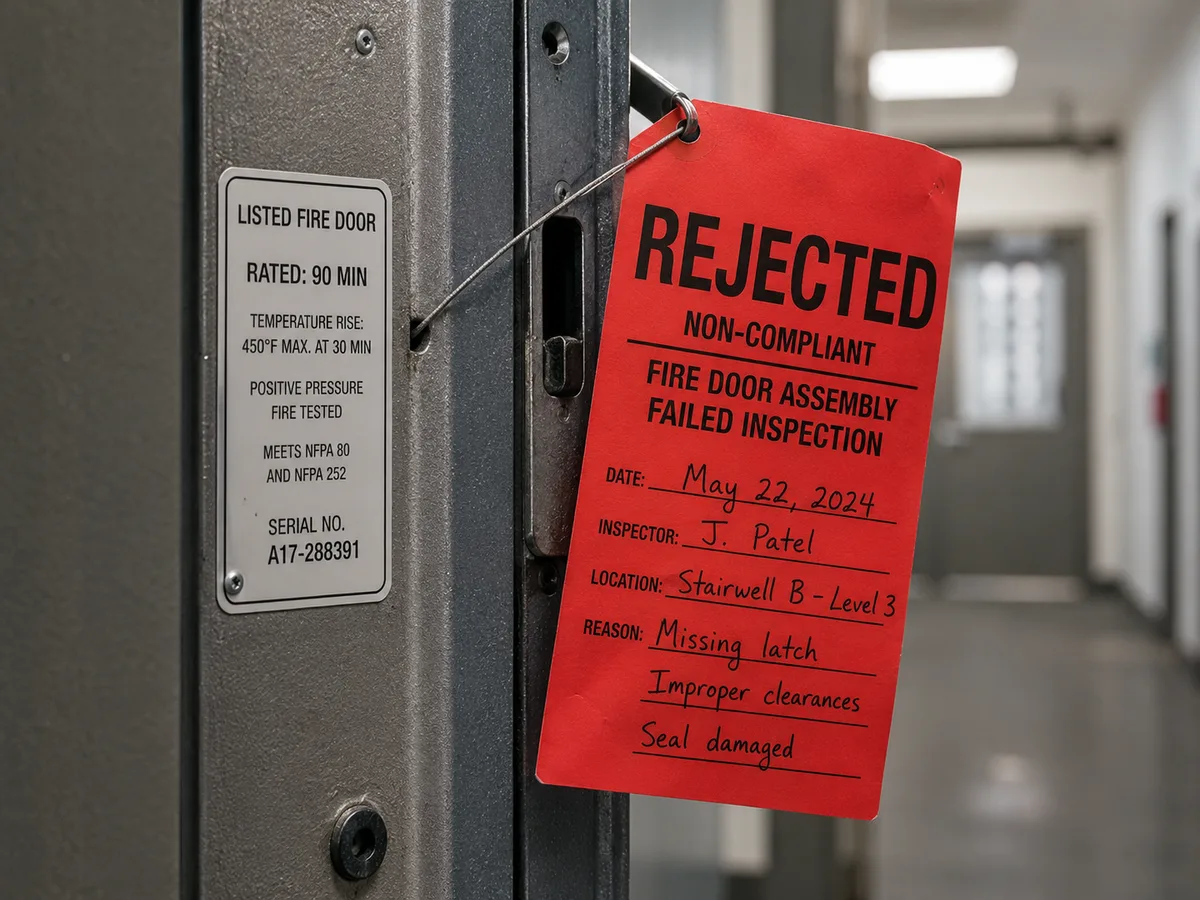
A fire-rated opening doesn't pass inspection because its parts are labeled fire-rated. It passes because the specific products, preparations, and configurations installed are covered by listing evidence for that assembly — and that evidence trail starts, or breaks, on the hardware schedule.
The scale of the problem is not hypothetical. The UK's Fire Door Inspection Scheme reported a 72% failure rate in its 2025 data, with earlier years running around 75% across more than 100,000 inspections. That's UK, in-service data rather than a U.S. NFPA 80 study — but the failure modes have clear parallels in any U.S. fire-door inspection, and the distribution of causes is the instructive part.
Some failures are genuinely field conditions: excessive clearances, damaged or missing seals, poor maintenance, doors wedged open. No schedule prevents a wedge. But a second, quieter category begins much earlier — during product selection, listing verification, and hardware scheduling — and then waits months to surface as an inspection finding. Those are the preventable ones, and they're preventable at estimating time.
What makes a rated opening different from any other line on the schedule?
An ordinary opening has to be orderable and correct. A rated opening has to be orderable, correct, and evidenced: every component's presence on that door must fall within the scope of a listing for that assembly. The rating on the door tag is the easy part. The evidence behind it is where rated openings actually pass or fail.
That difference changes what "reviewing the schedule" means. For a rated opening, each hardware line implicitly claims this product, in this configuration, is permitted in this listed assembly — and that claim needs checking like any other fact.
The five schedule-level risks worth catching before fabrication
1. Closer selection and adjustment. The closer must reliably close and positively latch the opening under its actual operating conditions — a rated door that doesn't latch is a failed door, whatever its label says. Door size, weight, pressure conditions, application, and listing requirements should be resolved during scheduling. When they're guessed in the field, the guess is what gets inspected. (This evidence is printable, not tribal: a Grade 1 closer like the LCN 4040XP carries its UL 10C listing and ADA opening-force figures in its own catalog specifications — exactly what should travel with the opening.)
2. Hinge quantity, type, and rating. Hinge requirements depend on door height, weight, construction, application, and the listed assembly. This is the trap of the plausible hinge: a product that looks entirely suitable while being the wrong type, quantity, or rating for that specific opening. Plausibility is exactly what a schedule review based on eyeballing will confirm.
3. Required protection at hardware preparations. Where the listed assembly requires protection around locks, strikes, closers, or other hardware preps, that protection must be specified — on the schedule — and installed. Having the right lock does not compensate for a missing assembly detail around the hole cut for it. This is the easiest of the five to lose, because it's a requirement about a line item rather than a line item itself.
4. Locks and latches without listing evidence. "Fire-rated" in a product description is a marketing category; a listing is a scoped document. A product can be legitimately fire-rated and still not be listed for this door type, this preparation, this application. The schedule line needs evidence that this specific product and configuration are permitted in this assembly — not a general assurance that the product family is rated.
5. Listing and label scope. The subtlest failure: the label is present, the documentation exists, and the installed configuration still falls outside the listing's scope — a size beyond the listed range, a preparation the listing doesn't cover, an application it wasn't evaluated for. Label present and label applicable are different findings, and inspectors check the second one.
Why these are information failures, not hardware failures
Read the five again and notice what's absent: nobody bought bad hardware. In every case the failure is a missing or unverified piece of information — a requirement that never made it onto the schedule line, a listing that was assumed rather than verified, a selection decision deferred to the field. It's the schedule-translation problem wearing its most expensive costume — the same problem that keeps hardware schedules from arriving order-ready in the first place.
The industry files these under field problems because that's where they surface — at the inspection walk, at closeout, in the punch list. But surfacing late is not the same as originating late. A closer that was never sized for the door's actual conditions was wrong at scheduling time; the field just inherited it. Filing scheduling failures as field failures guarantees the same failures next project, because the fix gets applied to the wrong stage.
If you've ever specced a rated opening, one of the five just came to mind — usually the one your last closeout got flagged on.
What a schedule-level check actually looks like
The estimating-time review for rated openings reduces to a per-opening discipline:
- Tag every rated opening's lines as claims needing evidence, not just items needing prices. The review question is "what shows this is permitted in this assembly?" — per product, per preparation.
- Resolve selection decisions on the schedule, not in the field. Closer sizing against door size, weight, and pressure; hinge count and rating against height, weight, and construction. If the schedule doesn't carry enough information to make the selection, that itself is the finding.
- Check scope, not presence. For each listing relied on: does it cover this door size, this preparation, this configuration, this application? A listing cited outside its scope is worth exactly as much as no listing.
- Make requirements-about-items explicit line items. Required protection at preps, required accessories, required configurations — anything the listing demands that isn't itself a product needs to exist on the schedule where it can be priced, ordered, and verified, or it will simply not happen.
- Keep the evidence attached to the opening. A verification that lives in an email thread is unavailable at the inspection walk. The requirement, the selection rationale, and the listing reference should travel with the opening through estimating, ordering, and closeout.
None of this is exotic. It is the checklist a senior AHC runs in their head on every rated opening — which is precisely the problem, because heads don't scale to four hundred doors and don't stay employed forever. This is what we're building into Conversant's estimating workflow: closer requirements, hinge criteria, rated hardware, and assembly evidence traveling with each opening, so a mismatch flags before fabrication instead of during the inspection walk.
A 72% failure rate is not a maintenance statistic. It's a measurement of how much information the industry loses between specification and installation. The schedule is where that information either gets captured — or starts its long, quiet wait to become a finding.